Most full-costume Disney characters, including Mickey Mouse, Minnie Mouse, Donald Duck, Goofy and Pluto, do not normally speak during character meet-and-greets. Instead, they communicate through gestures, poses, hugs, facial movement in the costume and exaggerated body language.
That does not mean Disney characters are all silent. Princesses and other human characters such as Cinderella, Tiana, Ariel and Peter Pan can talk directly with guests because the performer’s own face and voice are part of the character interaction.
Disney currently refers to the full-costume roles as sculpted characters and to performers portraying human characters as Character Look-Alikes. Once you understand that distinction, the reason Mickey behaves differently from Cinderella makes much more sense.
| Type of Disney Character | Examples | Do They Talk to Guests? |
|---|---|---|
| Sculpted character | Mickey, Minnie, Donald, Goofy, Pluto | Usually no; they communicate through gestures |
| Character Look-Alike | Cinderella, Tiana, Ariel, Peter Pan | Yes, during appropriate meet-and-greets |
| Special character technology or entertainment | Varies by show or experience | May use prerecorded or specialized voices |
Why Doesn’t Mickey Mouse Talk at Disney World?
Mickey Mouse normally communicates nonverbally during Walt Disney World meet-and-greets. He poses for photos, gives hugs and high-fives, signs autographs and reacts to guests through expressive movements rather than having a spoken conversation.
This is not because the performer simply isn’t allowed to interact. Nonverbal interaction is part of the performance itself.
Disney’s current Character Performer audition information gives an interesting look at how that works. Candidates may be asked to perform an “animation exercise” that Disney describes as being similar to charades. Disney is specifically looking for performers who can bring a character to life through movement.
That makes sense when you see Mickey interact with a guest. He can point to a Mickey shirt, cover his face dramatically, pretend to laugh, blow a kiss, react to a child’s story or celebrate an autograph without saying anything.
Why Do Full-Costume Disney Characters Stay Silent?
Disney does not publish a simple rule saying, “Mickey doesn’t talk because of this one reason.” I would be cautious with websites that claim there is one secret explanation.
What Disney does publicly confirm is that sculpted-character performers work inside potentially large body costumes, heads and feet, sometimes with limited vision and range of motion. Their auditions emphasize movement and animation rather than spoken character dialogue.
The nonverbal format also creates a consistent character interaction. Different trained performers can portray the same sculpted character while guests continue to encounter the same familiar gestures and personality.
A Mickey performer does not need to reproduce Mickey’s animated voice perfectly during hundreds of individual conversations. Instead, the performer concentrates on physical characterization and reacting visually to each guest.
If you’re curious about the physical side of the job, my guide to how long Disney characters stay in costume explains more about the demands of performing inside a sculpted character costume.
Which Disney Characters Do Talk?
Many human Disney characters speak normally with guests during character greetings.
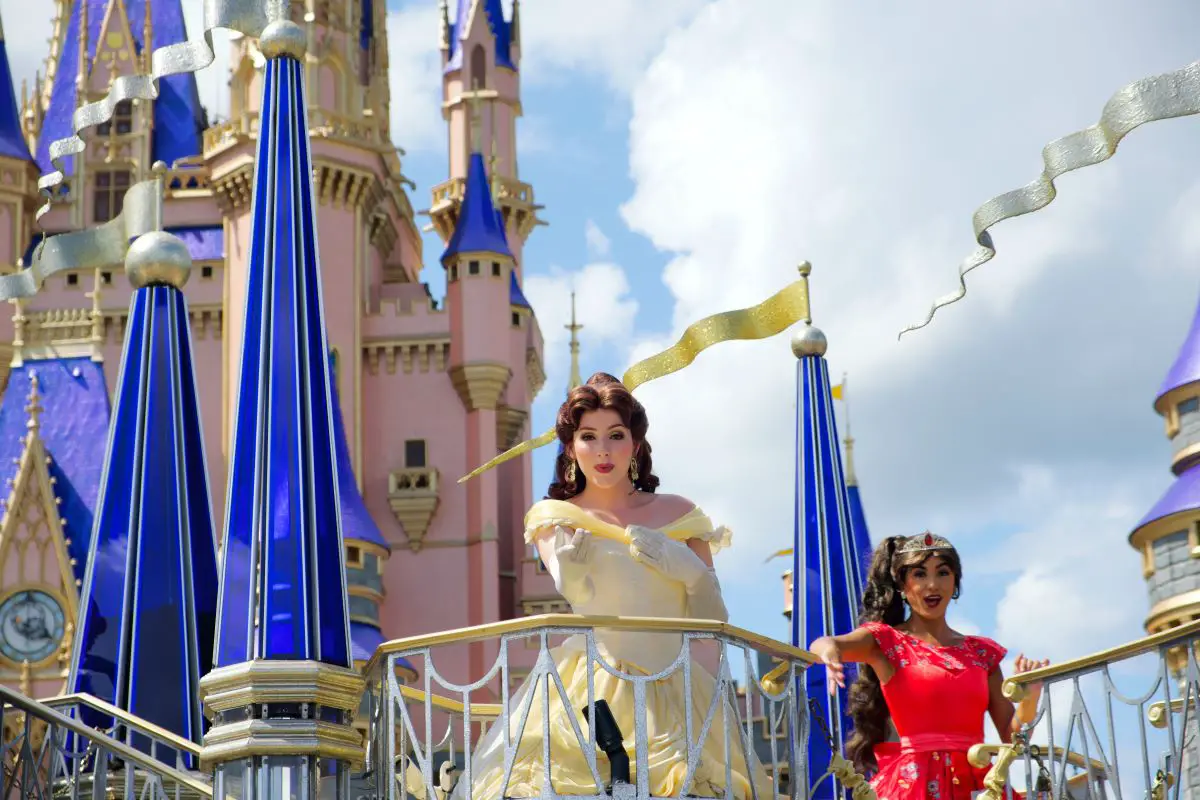
Disney’s official Walt Disney World princess information specifically invites guests to chat with Disney princesses. Depending on current character schedules, that can include Cinderella, Tiana, Ariel, Jasmine, Mulan, Aurora, Belle and Snow White.
Other human characters can speak as well. Peter Pan, for example, appears as a live character performer rather than behind a sculpted character head.
These interactions can become much more conversational. You can ask a princess about another character from her movie, mention something from her story or simply have a normal conversation while the performer responds in character.
Sculpted Characters vs. Character Look-Alikes
You will often hear Disney fans refer to “fur characters” and “face characters,” but Disney’s current casting language is different.
Disney calls characters performed inside complete body costumes sculpted characters. The performer may wear a large character head, body pieces and character-specific feet.
Human characters portrayed by performers whose actual faces are visible are referred to in current casting materials as Character Look-Alikes.
Interestingly, Disney says Character Look-Alike performers also perform as fully costumed sculpted characters. A performer who appears as a speaking human character can therefore also work in completely different full-costume roles.
Disney also casts sculpted characters within particular physical ranges so the character looks consistent from one performer to another. My Disney character height requirements guide goes deeper into that part of the casting process.
Does Mickey Mouse Ever Talk at Disney World?
Mickey can have a voice in shows, attractions and prerecorded entertainment, but the Mickey you meet during a normal Walt Disney World character greeting does not currently hold a spoken conversation with guests.
That has not always been the case.
Walt Disney World previously offered a special talking Mickey Mouse experience at Town Square Theater in Magic Kingdom. The character could speak directly with guests as part of the meet-and-greet.
That version of Mickey eventually stopped talking in 2018. Disney’s planDisney service later confirmed that Mickey no longer talked to guests at Town Square Theater.
Today, Disney’s official description of the Town Square Theater experience focuses on meeting Mickey, posing for photographs and enjoying the character interaction rather than having a spoken conversation.
Why Did Disney Stop Talking Mickey?
Disney never published a detailed official explanation for why the talking Mickey experience ended.
Contemporary Disney news sites reported possible factors including technical complexity, operating cost and confusion when guests encountered a talking Mickey in one location but silent versions elsewhere. Those explanations were reported at the time, but I would not treat them as a definitive statement from Disney.
What we know for certain is that Talking Mickey ended and the current Town Square Theater meet-and-greet uses the traditional nonverbal Mickey interaction.
How Do Disney Characters Communicate Without Talking?
Watching the interaction rather than waiting for dialogue is the easiest way to appreciate a sculpted Disney character.
Characters use exaggerated movement because it has to communicate clearly through a large costume. Common reactions include:
- Nodding and shaking their heads
- Pointing to clothing, pins or souvenirs
- Putting their hands over their mouth in surprise
- Mime-style reactions to questions
- Hugs, high-fives and hand gestures
- Posing or acting out a joke for a photograph
- Signing autographs when that character is able to do so
The interaction can still be surprisingly personal. If you mention something related to the character’s story, the performer will often find a physical way to respond.
For example, a Donald Duck performer might react dramatically if you tell him Mickey is your favorite. Mickey might point excitedly at a shirt with his picture on it. Those kinds of reactions are the conversation.
Why Not Just Put a Microphone Inside the Costume?
It sounds simple, but adding a microphone would not automatically create Mickey Mouse’s recognizable voice.
The performer would still need to deliver a convincing character voice while simultaneously moving inside a large costume, seeing through limited sightlines, interacting with guests and maintaining the physical performance.
Disney has experimented with more complicated character technology, as the former Talking Mickey experience demonstrated. But Disney does not currently use that system for the standard Mickey Mouse meet-and-greet at Walt Disney World.
Why Don’t Mascots Talk?
People also search this question using the word “mascot.” Disney does not normally describe Mickey and its other park characters as mascots, but the same basic performance style is familiar from sports and entertainment mascots.
A performer inside a full-head character costume can communicate broadly and consistently with gestures without relying on the performer’s natural speaking voice. Physical reactions are also easier to see in a noisy environment than subtle facial expressions hidden behind a costume head.
Disney takes that style much further by training performers around the personality, movements and mannerisms of a specific character.
What Should You Say to a Silent Disney Character?
You do not have to stay silent just because Mickey does.
Talk to the character normally. Tell them who your favorite character is, compliment their outfit, mention something from their movie or show them a souvenir connected to their story.
The performer will respond through movement, and those reactions can make the interaction much more memorable than simply walking up for a photograph.
Many characters can also sign autographs. If that’s part of your plan, my guide to Disney character autographs explains what to expect.
What to Expect When Meeting Mickey and Other Sculpted Characters
When you meet Mickey, Minnie, Donald, Goofy or another sculpted character, expect a physical interaction rather than a spoken one.
You can still talk to them. They may react to what you say, pose for photographs, give hugs or high-fives and sign autographs depending on the character and location.
If you specifically want a conversational character experience, meeting a princess or another Character Look-Alike is a better choice. Disney currently advertises its princess greetings as opportunities to chat directly with the characters.
You can browse my broader Disney characters guide if you’re deciding who you want to meet during your trip.
So Why Don’t Disney Characters Talk?
The better way to phrase it is that Disney’s sculpted characters usually communicate nonverbally. Mickey, Minnie, Donald, Goofy and similar full-costume characters rely on trained movement and gestures during standard meet-and-greets instead of the performer speaking through the costume.
Characters whose performers’ faces are visible, including many Disney princesses and other Character Look-Alikes, can speak directly with guests.
Disney experimented with a talking Mickey at Magic Kingdom in the past, but that experience ended in 2018. Today’s Mickey meet-and-greet has returned to the traditional nonverbal format.
Once you stop waiting for Mickey to answer out loud, the gestures start to make much more sense. For sculpted Disney characters, body language is the performance.