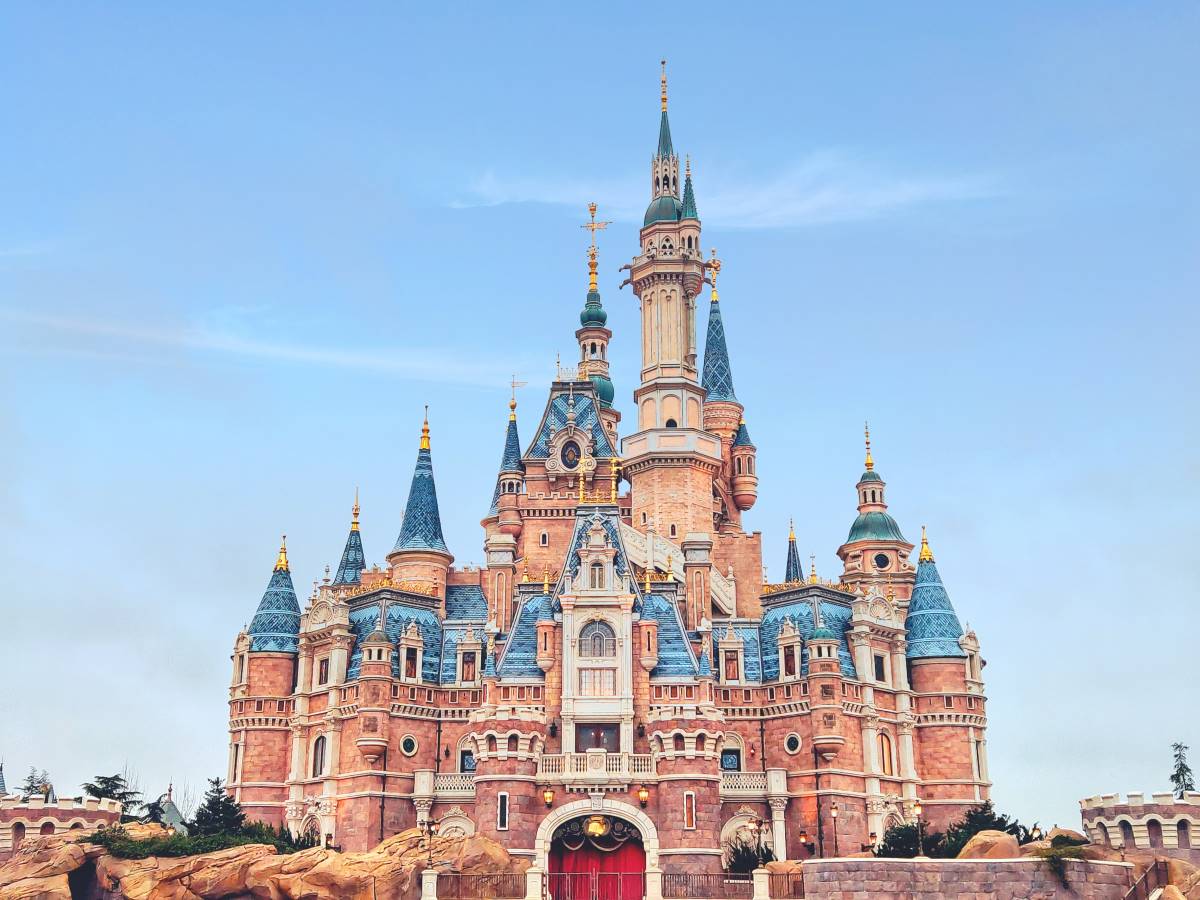
Disney’s Animal Kingdom is the largest Disney theme park in the world by commonly reported acreage, covering more than 500 acres. EPCOT comes next at approximately 300 acres, followed by Shanghai Disneyland, whose original park site was reported at roughly 225 acres.
But ranking all 12 Disney theme parks from largest to smallest gets complicated. Some published figures include backstage facilities, others measure guest-accessible areas, and several parks have expanded since their original acreage was reported.
I find the numbers useful for understanding how spread out a park might feel, but they are not a reliable way to predict how much walking you will do. Here’s how the parks compare, where the numbers come from, and which parks actually feel the biggest when you’re visiting.
Disney parks from largest to smallest based on commonly cited park size
There are 12 Disney theme parks across six resorts worldwide. The table below uses published park-area figures where available and commonly cited estimates elsewhere. It is a practical comparison, not a standardized land survey.
| Rank | Disney theme park | Approximate size |
|---|---|---|
| 1 | Disney’s Animal Kingdom, Florida | More than 500 acres; often listed at about 580 |
| 2 | EPCOT, Florida | 300 acres |
| 3 | Shanghai Disneyland, China | 225 acres at initial development, including backstage areas |
| 4 | Tokyo DisneySea, Japan | 151 acres |
| 5 | Magic Kingdom, Florida | 142 acres |
| 6 | Disney’s Hollywood Studios, Florida | 135 acres |
| 7 | Tokyo Disneyland, Japan | 126 acres |
| 8 | Disneyland Park, Paris | 124 acres |
| 9 | Disneyland Park, California | About 100 acres |
| 10* | Disney California Adventure, California | About 72 acres commonly cited; Anaheim lists 57 |
| 11* | Hong Kong Disneyland | About 68 acres of public park area |
| Not ranked | Disney Adventure World, Paris | Formerly about 62 acres; expanded in 2026 |
*The order of the smallest parks depends on what is included in the measurement. Disney California Adventure is commonly described as 72 acres, but the City of Anaheim’s 2026 fact sheet lists 57 acres. That would place it below Hong Kong Disneyland’s commonly reported 68-acre public area. Disney Adventure World cannot be placed confidently using its old pre-expansion acreage.
The top of this ranking is much more certain than the bottom. Animal Kingdom is comfortably the largest, while the middle positions become clearer when you use current figures from the park operators.
What is the biggest Disney park in the world?
Disney’s Animal Kingdom at Walt Disney World is the biggest Disney theme park. Disney describes it as covering more than 500 acres, much of which is devoted to animal habitats, landscaping, conservation facilities, and large attractions such as Kilimanjaro Safaris.
If you mean the biggest Disneyland-branded castle park, rather than any Disney theme park, Shanghai Disneyland is generally considered the largest based on its roughly 225-acre original park site. That figure is not the same as the much larger Shanghai Disney Resort property.
What is the smallest Disney park?
Hong Kong Disneyland is commonly called the smallest Disney theme park, at approximately 68 acres of public area. However, there is an important qualification: Anaheim’s official figure of 57 acres for Disney California Adventure would make that park smaller under the city’s measurement.
Disney Adventure World in Paris adds another complication. Its old 62-acre figure is still repeated online, but the park opened its World of Frozen expansion in March 2026. Disney says the wider transformation nearly doubles its size, so it would be misleading to keep treating the former Walt Disney Studios Park footprint as the current figure.
Why this ranking gets confusing fast
I’ve noticed that many Disney park-size lists repeat the same numbers without explaining what those numbers measure. That matters more than it might seem, especially when two parks are close in size.
Resort acreage is different from theme park acreage
Shanghai Disney Resort is the clearest example. Disney’s official fact sheet describes the resort as covering approximately 963 acres. That includes hotels, Disneytown, recreational areas, and other resort property. It does not mean Shanghai Disneyland itself is a 963-acre theme park.
The park’s original site was reported at about 225 acres, including backstage areas. Shanghai has since added Toy Story Land and Zootopia, so that older park-only number should be treated as a historical reference rather than a precise current measurement. I explain that comparison in more detail in my guide to how big Shanghai Disneyland is.
The same issue comes up when comparing Disneyland and Disney World by size. Walt Disney World occupies an enormous property in Florida, but most of that land is not inside its four theme parks.

Older measurements can change a park’s position
Tokyo DisneySea is a good example of why current operator figures matter. Older lists often place it at about 176 acres. However, Oriental Land Company’s 2026 Fact Book lists Tokyo DisneySea at 610,000 square meters, or approximately 151 acres, and Tokyo Disneyland at 510,000 square meters, or approximately 126 acres.
Those are published theme park area figures from the company that operates Tokyo Disney Resort. They are a better basis for comparing the two Tokyo parks than repeating older estimates. For more context, see my breakdown of Tokyo Disneyland’s size.
Disney Adventure World has outgrown its old ranking
Disneyland Paris historically reported Walt Disney Studios Park at 25 hectares, or approximately 62 acres. Disneyland Park next door is listed at 50 hectares, or roughly 124 acres.
On March 29, 2026, the second park became Disney Adventure World with the opening of World of Frozen and its expanded lakefront area. Disney describes the transformation as nearly doubling the park’s size. Until a clearly comparable current park-area measurement is available, I would not assign Disney Adventure World an exact position in the worldwide ranking.

The Disney parks that feel the biggest when I walk them
Acreage tells you how much land a park occupies. It does not tell you how long the paths are, how far apart the attractions sit, or how much of that space guests can actually explore.
Animal Kingdom feels expansive in a different way
Animal Kingdom is the park that feels the biggest to me in the most obvious way. There is more visual breathing room, more landscaping, and longer distances between certain attractions. The animal habitats make its scale feel different from a conventional ride-focused theme park.
But that does not mean guests walk across all 500-plus acres. Much of the property is devoted to spaces you cannot explore on foot. What you actually experience is a collection of themed areas connected by paths that can still make for a long, hot afternoon.
EPCOT is where the walking adds up
EPCOT is the park where I tend to feel the mileage in my feet the most. Its approximately 300-acre footprint is smaller than Animal Kingdom’s, but the distances between destinations can be substantial.
A full World Showcase circuit, combined with time in World Celebration, World Discovery, and World Nature, can turn into a surprisingly long day. I pay more attention to meal locations and backtracking at EPCOT than I do at a smaller park.

Disneyland feels smaller but more concentrated
Disneyland Park in California is nowhere near Animal Kingdom’s size, yet its density is part of the appeal. Major attractions are packed into a relatively compact space, and I can often move between different lands without the kind of long walk I would expect at EPCOT.
That is one reason I think Disneyland’s approximately 100-acre footprint works so well. It feels busy and full of things to explore, but I do not need an enormous amount of time just to cross the park. My guide to how big Disneyland is looks more closely at its size and walking distances.
The smallest Disney parks do not always feel small
Hong Kong Disneyland and Disney California Adventure show why I would not use acreage as a shortcut for judging the quality of a Disney park.
Hong Kong Disneyland
Hong Kong Disneyland has a reputation for being one of the smallest Disney parks, and its commonly reported 68-acre public area helps explain that. But it also contains major themed experiences, including Mystic Point, Grizzly Gulch, and World of Frozen.
A compact park can be an advantage when you want an easier day with less walking between attractions. Just remember that the resort itself is much larger: Disney’s official fact sheet puts Hong Kong Disneyland Resort at 310 acres, including its hotels and other facilities.

Disney California Adventure
California Adventure is another relatively compact park, particularly compared with the Florida parks. Cars Land, Pixar Pier, Avengers Campus, and the park’s other areas occupy a footprint that is easy to underestimate because the experiences are so different from one another.
It also shows the limits of using a single acreage number. You will frequently see 72 acres cited, while Anaheim’s 2026 DisneylandForward fact sheet records the park at 57 acres. Those measurements should not be assumed to use identical boundaries.
Disney World parks ranked by size
If you are comparing only the four Walt Disney World theme parks in Florida, the ranking is more straightforward:
- Disney’s Animal Kingdom: More than 500 acres
- EPCOT: Approximately 300 acres
- Magic Kingdom: 142 acres
- Disney’s Hollywood Studios: Approximately 135 acres
That makes Animal Kingdom the biggest Disney World park and Hollywood Studios the smallest by commonly reported acreage. Magic Kingdom is larger than Hollywood Studios, despite older comparisons that list Magic Kingdom at 107 acres.
For actual trip planning, those numbers matter less than the attractions you prioritize. I would still build my schedule around ride locations, dining reservations, and realistic breaks. My Disney World planning guide is a better starting point for that than park size alone.
Does the largest Disney park take the longest to visit?
Not necessarily. Animal Kingdom is the largest, but its enormous wildlife areas do not translate into an equally enormous number of rides. EPCOT can require more walking than you expect, while Magic Kingdom may take longer to explore thoroughly because it has so many attractions concentrated inside a smaller footprint.
In practical terms, I would think about each park this way:
- Animal Kingdom: Allow time for the safari, animal trails, shows, and walking between themed areas.
- EPCOT: Plan your route to avoid repeatedly crossing the park.
- Magic Kingdom: Expect a full schedule even though the park is smaller than EPCOT.
- Disneyland: Take advantage of the compact layout, but account for crowds and attraction wait times.
Park size affects your day, but it does not determine whether a park is better or whether you need one day or two. The attraction lineup, walking routes, and your priorities are far more useful measurements.

Where these Disney park-size figures come from
For measurements that can be checked directly, I favor figures published by Disney, the park operator, or the local government:
- Oriental Land Company’s Fact Book publishes the current theme park areas for Tokyo Disneyland and Tokyo DisneySea.
- Disneyland Paris’s company information lists Disneyland Park at 50 hectares and also contains the older 25-hectare figure associated with its second park.
- Disney Parks Blog identifies Magic Kingdom as a 142-acre park.
- The City of Anaheim’s DisneylandForward fact sheet provides park-area figures for Disneyland and Disney California Adventure.
The simplest way to remember the ranking: Animal Kingdom is the largest Disney theme park, EPCOT is next, and Hong Kong Disneyland and California Adventure are among the smallest. For the parks in between, the published acreage and the way that land is measured both matter.