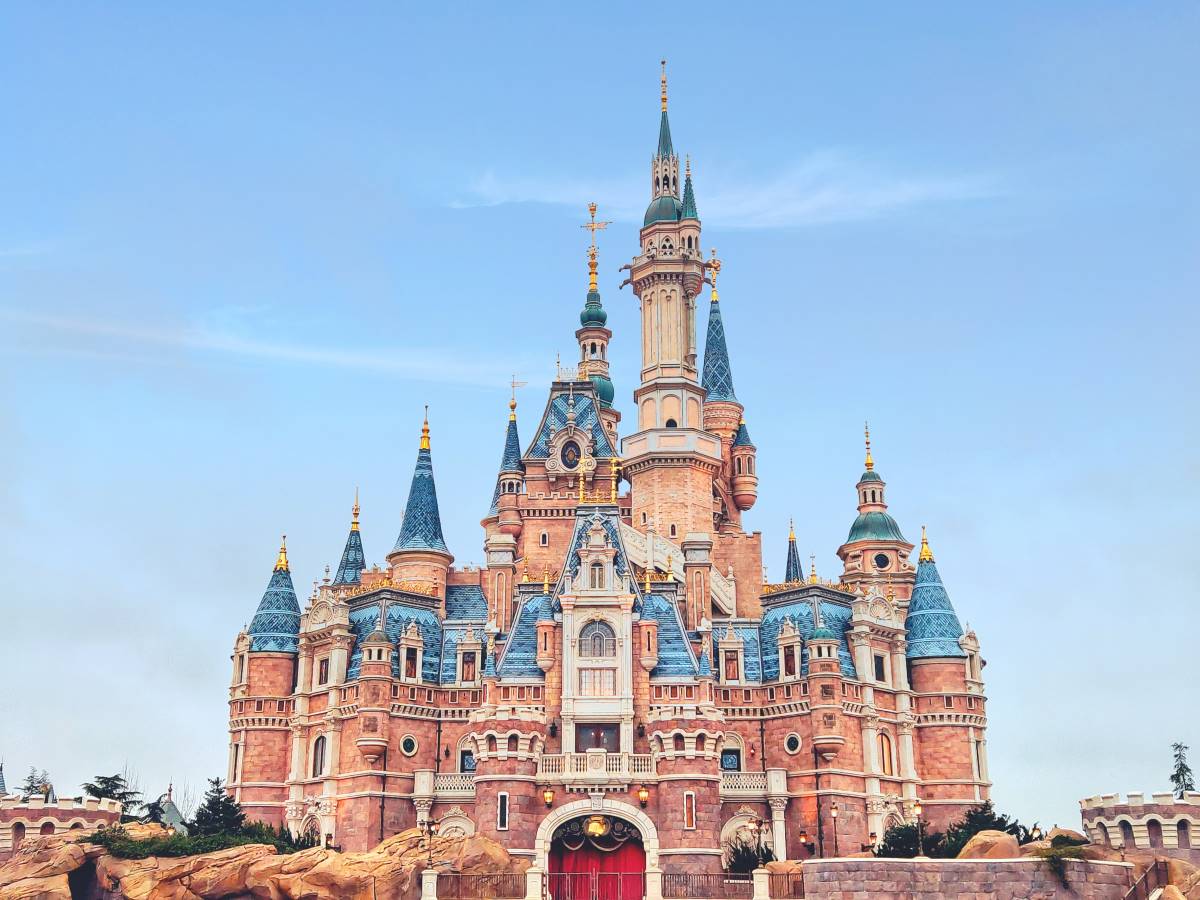
If you’re looking for the real-life Disney castle, there isn’t just one. Disneyland’s Sleeping Beauty Castle was inspired by Neuschwanstein Castle in Bavaria, while Walt Disney World’s Cinderella Castle drew from several French palaces and châteaux rather than a single building.
That distinction gets lost in a lot of lists online. Neuschwanstein has the clearest one-to-one connection: Disney itself identifies the Bavarian castle as an inspiration for Sleeping Beauty Castle. Cinderella Castle is more of an architectural blend, combining ideas from places including Fontainebleau, Versailles, Chenonceau, Chambord and Chaumont with designs from Disney’s 1950 Cinderella film.
I’ve visited some of these castles myself, and what stands out in person is how Disney borrowed architectural language rather than simply copying a building. Towers get exaggerated, rooflines become cleaner, and centuries of European architecture are distilled into something that reads instantly as a fairy-tale castle.
Which Real Castles Inspired Disney?
| Real Castle or Palace | Disney Connection | What We Know |
|---|---|---|
| Neuschwanstein Castle | Sleeping Beauty Castle at Disneyland | Disney explicitly identifies Neuschwanstein as an inspiration |
| Château de Fontainebleau | Cinderella Castle at Magic Kingdom | One of the European palaces studied by Disney designers |
| Palace of Versailles | Cinderella Castle at Magic Kingdom | One of the European palaces studied by Disney designers |
| Château de Chenonceau | Cinderella Castle at Magic Kingdom | One of the French châteaux studied during development |
| Château de Chambord | Cinderella Castle at Magic Kingdom | One of the French châteaux studied during development |
| Château de Chaumont | Cinderella Castle at Magic Kingdom | One of the French châteaux studied during development |
| Alcázar of Segovia | Often connected with Disney castle imagery | Frequently associated with Disney, especially Snow White, but the connection is less direct than Neuschwanstein’s documented Disneyland link |
What Castle Inspired Disneyland’s Sleeping Beauty Castle?
Neuschwanstein Castle in Bavaria, Germany, is the most clearly documented real-world inspiration for Sleeping Beauty Castle at Disneyland.

Disneyland’s own history of Sleeping Beauty Castle says it was inspired by Neuschwanstein. Disney has also explained that Imagineers looked at several European medieval castles when developing the 77-foot landmark, so Neuschwanstein should not be treated as the only architectural reference.
Still, this is the real castle where the visual relationship is easiest to understand. Seeing Neuschwanstein in person, what struck me most was the silhouette: pale walls, narrow towers, dark roofs and a dramatic elevated setting that makes the building seem almost staged against the landscape.
That’s why Neuschwanstein is usually the best answer when someone asks, “What castle in Europe inspired Disney?” If they’re talking about Disneyland’s Sleeping Beauty Castle, the connection is real.
What Inspired Cinderella Castle at Disney World?
Cinderella Castle at Walt Disney World was not modeled after one real castle.
According to Disney’s D23 archive, the design team studied famous European palaces and castles including:
- Château de Fontainebleau
- Palace of Versailles
- Château de Chenonceau
- Château de Chambord
- Château de Chaumont
The designers also referenced artwork created for Disney’s 1950 animated film Cinderella. Herb Ryman, who had worked on Sleeping Beauty Castle at Disneyland, served as the chief designer.
Disney describes Cinderella Castle as a romantic interpretation of a French palace-fortress. Its heavier lower section draws from Romanesque fortress architecture, while the towers and upper portions use more vertical Gothic forms.
So if you’re searching for the real Cinderella Castle, there isn’t a single building you can visit and say, “That’s it.” The Disney World castle is deliberately composite.
If you want to see how it differs from Walt Disney’s original park castle, I compare the two directly in my guide to Sleeping Beauty Castle vs. Cinderella Castle.
Château de Chambord and Cinderella Castle

Château de Chambord is one of the strongest places to look if you want to understand the French side of Cinderella Castle’s design.
Disney specifically identifies Chambord among the châteaux its designers studied. The most obvious visual connection is not that Cinderella Castle copies its façade. It is the elaborate upper silhouette.
Chambord’s roof is almost a miniature city of chimneys, dormers, towers and sculptural details. That dense vertical roofscape is very different from Neuschwanstein’s cleaner Bavarian profile and helps explain why Cinderella Castle feels more French Renaissance than medieval German.
Château de Fontainebleau and Cinderella Castle

Fontainebleau is another confirmed reference Disney designers studied while developing Cinderella Castle.
It is useful because it shows that the inspiration wasn’t limited to picturesque towers. Fontainebleau is a sprawling royal palace, and its sense of ceremony, symmetry and scale helps explain the more regal side of Cinderella Castle.
Disney World’s castle needed to feel like more than a medieval fortress. It had to read as a royal palace from the end of Main Street, U.S.A., and the French palace tradition gave Imagineers a different visual vocabulary from the one used for Disneyland’s smaller Sleeping Beauty Castle.
Versailles, Chenonceau and Chaumont Were Also Studied
Disney’s own historical record also names the Palace of Versailles and the châteaux of Chenonceau and Chaumont among the European buildings studied for Cinderella Castle.
That is important because it shows why searching for one “Cinderella Castle in real life” can be misleading. Imagineers were assembling a visual library rather than tracing a single building.
Different references could contribute different ideas: fortress-like lower walls, elegant proportions, pointed towers, decorative rooflines and the overall impression of European royalty.
What About the Alcázar of Segovia?

The Alcázar of Segovia in Spain is frequently described as a Disney castle inspiration, particularly in connection with the castle imagery in Snow White and the Seven Dwarfs.
Its dramatic position on a rocky outcrop, slate-covered towers and pointed silhouette certainly explain the association. Spanish cultural sources also describe it as having inspired Disney.
I would be more careful about calling it the real-life Cinderella Castle, though. Disney’s own D23 entry on Cinderella Castle specifically names Fontainebleau, Versailles, Chenonceau, Chambord and Chaumont among the European sites its designers studied.
That’s a useful distinction between a castle that is strongly associated with Disney imagery and one Disney itself identifies as a documented design reference.
Is Neuschwanstein the Cinderella Castle?
No, not exactly. This is one of the easiest Disney castle connections to mix up.
Neuschwanstein’s confirmed park connection is primarily to Sleeping Beauty Castle at Disneyland.
Cinderella Castle at Walt Disney World was developed later using a broader collection of French and European references plus artwork from the animated Cinderella.
The two Disney castles share enough fairy-tale design language that photos are often mislabeled online, but they have different architectural histories.
Are Disney Castles Copies of Real Castles?
No. Disney castles are better understood as combinations of real architecture, animated-film design and Imagineering exaggeration.
Disney’s own histories describe Sleeping Beauty Castle as drawing from multiple European medieval castles and Cinderella Castle as combining different European architectural influences.
That is why you can visit Neuschwanstein and immediately recognize something Disney-like without finding a perfect Disneyland duplicate, or walk around Chambord and recognize architectural ideas without seeing Cinderella Castle sitting in the Loire Valley.
Why So Many Disney Castles Look French or German
The connection goes deeper than the theme parks.
Disney artists were heavily influenced by French and German art and architecture when developing fairy-tale settings. That visual tradition fed both the animated films and, eventually, the castles built inside Disney parks.
French châteaux provide elegant façades, steep roofs and elaborate towers. German Romantic architecture such as Neuschwanstein contributes the dramatic mountain-fortress silhouette most people immediately associate with a fairy-tale castle.
The park versions then simplify those ingredients so the castle remains recognizable from a great distance and works as the visual center of the park.
Which Real Disney Castle Should You Visit?
If you want the clearest real-world connection to a Disney park castle, I would choose Neuschwanstein Castle. It is the easiest place to stand in front of a real building and immediately understand why people call it the real-life Disney castle.
If you’re specifically interested in Cinderella Castle at Walt Disney World, the Loire Valley is more revealing. Chambord, Chenonceau and Chaumont show the French architectural tradition Imagineers studied rather than offering one exact Cinderella Castle counterpart.
For a broader look at how Disney adapted the castle idea at each resort, see my guide to Disney castles around the world. If you’re more interested in how the designs changed over time, I also have a separate history of Disney park castles.
The Short Answer
If someone asks which castle inspired Disney, the most useful answer is:
- Sleeping Beauty Castle at Disneyland: Neuschwanstein Castle is the best-known and officially acknowledged real-world inspiration, alongside other European medieval castles.
- Cinderella Castle at Walt Disney World: there is no single real Cinderella Castle. Disney designers studied Fontainebleau, Versailles, Chenonceau, Chambord and Chaumont and also used designs from the animated Cinderella.
That difference is the key to understanding the real castles behind Disney. The park castles were never meant to be replicas. They are carefully edited combinations of real European architecture and Disney’s own fairy-tale design language.