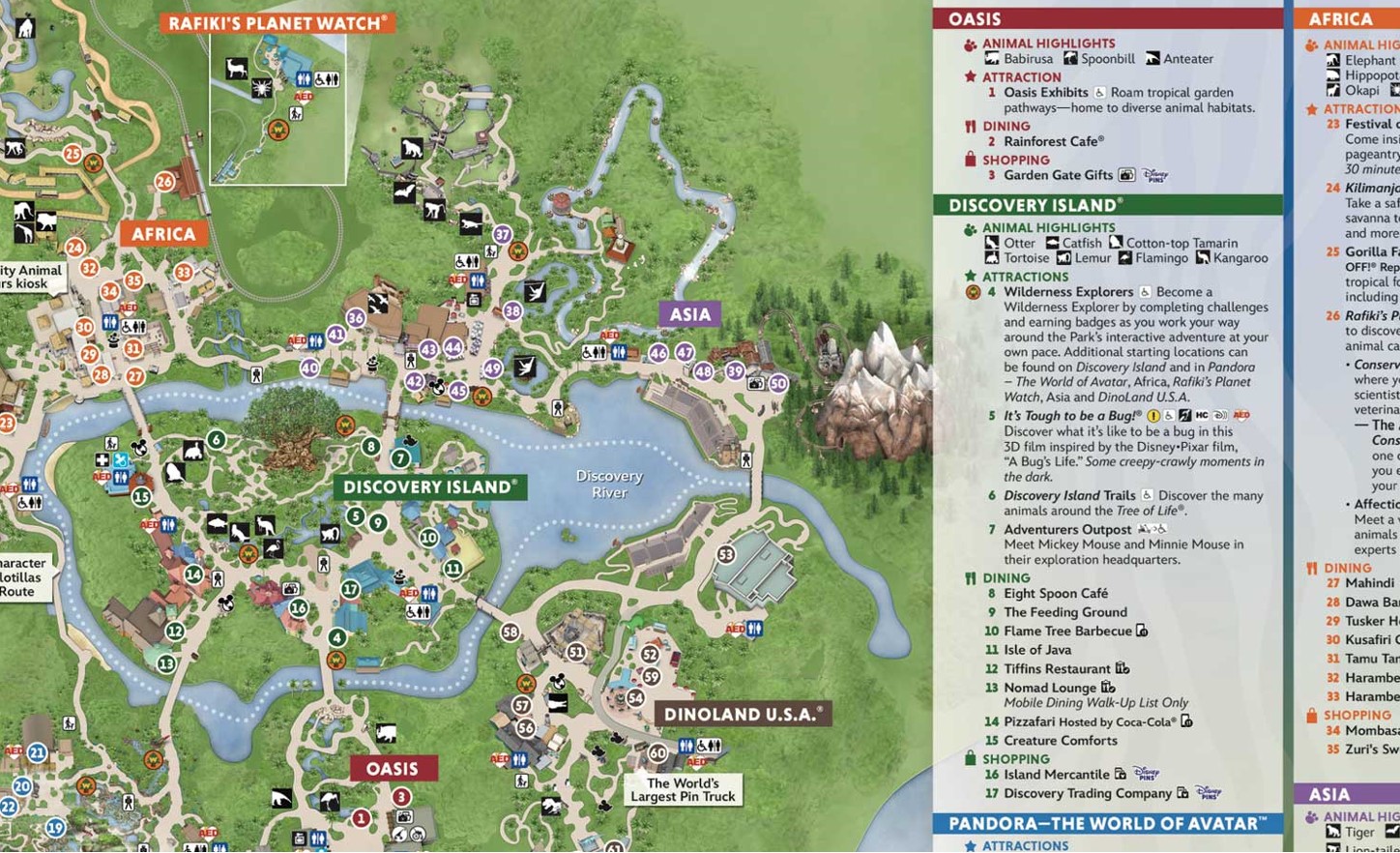
If you’re looking for the current Disney Animal Kingdom map, the biggest change is easy to spot: DinoLand U.S.A. is gone from the park map. That entire section is now marked as the future home of Tropical Americas, which Disney plans to open in 2027.
The rest of Animal Kingdom still revolves around Discovery Island and the Tree of Life, with Pandora to the left, Africa toward the back, Asia to the right, and Conservation Station reached by train from Africa.
That link opens Disney’s current printable guide map. For live wait times, showtimes and walking directions, I would use the My Disney Experience app once you’re inside the park.
What Changed on the Current Animal Kingdom Map?
The Animal Kingdom map changed more substantially in 2026 than it has in years.
- DinoLand U.S.A. is no longer on the map. DINOSAUR, Restaurantosaurus and the remaining DinoLand locations permanently closed in February 2026.
- The former DinoLand area is now marked for Tropical Americas. Disney is building an 11-acre land called Pueblo Esperanza with attractions based on Encanto and Indiana Jones. It is scheduled to open in 2027.
- Zootopia: Better Zoogether! is now inside the Tree of Life. It replaced It’s Tough to Be a Bug.
- Bluey’s Wild World is at Conservation Station. You reach it by taking the Wildlife Express Train from Africa.
If you’re comparing the current map with an older Animal Kingdom guide, those are the changes most likely to cause confusion. I keep a separate Animal Kingdom ride closures guide for attractions and areas that have recently disappeared or changed.
Animal Kingdom Layout at a Glance
Animal Kingdom is easier to understand once you stop thinking of it as one large loop.
You enter through the Oasis, which leads directly to Discovery Island and the Tree of Life. Discovery Island is the main hub that connects most of the park.
| Area | Where it is | Major things you’ll find there |
|---|---|---|
| Oasis | Immediately after the entrance | Oasis Exhibits, Rainforest Cafe |
| Discovery Island | Center of the park | Tree of Life, Zootopia: Better Zoogether!, Tiffins, Flame Tree Barbecue |
| Pandora – The World of Avatar | Left of Discovery Island | Avatar Flight of Passage, Na’vi River Journey, Satu’li Canteen |
| Africa | Northwest of Discovery Island | Kilimanjaro Safaris, Festival of the Lion King, Gorilla Falls, Wildlife Express Train |
| Asia | Northeast of Discovery Island | Expedition Everest, Kali River Rapids, Maharajah Jungle Trek, Yak & Yeti |
| Conservation Station | Separate from the main walking area | Bluey’s Wild World, animal care experiences, Jumping Junction |
| Future Tropical Americas | Southeast side of the park | Currently under construction for the 2027 expansion |
If you’re deciding what deserves your time rather than simply where everything is located, my Animal Kingdom attractions guide ranks the current rides, shows and animal experiences separately.
Animal Kingdom Map With the Major Rides
The easiest way to avoid unnecessary walking is to group rides by land instead of chasing the shortest wait time across the entire park.
Pandora
- Avatar Flight of Passage
- Na’vi River Journey
Pandora sits to the left as you approach Discovery Island. If Flight of Passage is your first priority, this is usually the direction you’ll be moving at the beginning of the day.
Africa
- Kilimanjaro Safaris
- Wildlife Express Train to Conservation Station
Africa is also home to Festival of the Lion King and Gorilla Falls Exploration Trail, so this section can take considerably longer than it looks if you’re doing more than the safari.
Asia
- Expedition Everest – Legend of the Forbidden Mountain
- Kali River Rapids
Maharajah Jungle Trek and Feathered Friends in Flight are also here, making Asia another area where the map can underestimate how long you might actually spend.
Theater in the Wild
Finding Nemo: The Big Blue… and Beyond! remains open in the Theater in the Wild beside the Tropical Americas construction area. Don’t mistake the construction on that side of the park for the theater being inaccessible.
For a complete current ride inventory, use my list of all the rides at Animal Kingdom. Older maps and ride lists can still show DINOSAUR and other attractions that no longer exist.
The Most Important Shortcut Is Pandora to Africa
One of the easiest ways to waste steps at Animal Kingdom is to return to the Tree of Life every time you change lands.
Pandora connects directly with Africa near Festival of the Lion King. If you start the morning with Avatar Flight of Passage, you can continue toward Harambe and Kilimanjaro Safaris without walking all the way back through the center of Discovery Island.
Africa and Asia are also connected around the northern side of Discovery River, so you can continue around the upper half of the park rather than constantly returning to the central hub.
This is why I think Animal Kingdom works better as a series of connected areas than as a ride-by-ride checklist.
You Cannot Walk to Conservation Station
Conservation Station looks close to Africa on the map, but it is not connected to the rest of Animal Kingdom by a guest walking path.
You have to board the Wildlife Express Train in Harambe. Disney currently describes the ride as about seven minutes each way.
Once there, you’ll find animal care experiences, Bluey’s Wild World and Jumping Junction with Australian animals including kangaroos and wallabies.
I would therefore treat Conservation Station as its own block of time rather than something you casually walk past between attractions.
Where to Find Animal Trails on the Map
Some of Animal Kingdom’s best experiences aren’t represented by big ride icons.
- Gorilla Falls Exploration Trail: Africa, beside Kilimanjaro Safaris
- Maharajah Jungle Trek: Asia, near Kali River Rapids
- Discovery Island Trails: around the Tree of Life
- Oasis Exhibits: along the entrance pathways before Discovery Island
If animals are a major reason you’re visiting, my guide to the animals at Disney’s Animal Kingdom is more useful than trying to identify every habitat from the park map alone.
Use Your Meal Location to Avoid Crossing the Park
Animal Kingdom is spread out enough that I wouldn’t book lunch in one area while intentionally spending the surrounding hour on the opposite side of the park.
If you’re in Pandora, Satu’li Canteen is the obvious convenient option. Africa has Tusker House and Harambe Market. Asia has Yak & Yeti and several quick-service locations. Discovery Island has Tiffins, Nomad Lounge and Flame Tree Barbecue.
My best Animal Kingdom restaurants guide can help you choose the restaurant first. Then use the map to make sure it fits naturally into the rest of your route.
Don’t Plan With an Old Animal Kingdom Map
This matters more than usual right now because Animal Kingdom is in the middle of a major transformation.
If a map still shows DinoLand U.S.A., DINOSAUR, The Boneyard or It’s Tough to Be a Bug!, it is no longer an accurate representation of the current park.
The current Disney map instead shows the future Tropical Americas area, Zootopia: Better Zoogether! at the Tree of Life and the newer Conservation Station offerings.
Construction can also affect how parts of the southeast side of the park feel, so I would check Disney’s map again shortly before traveling rather than relying on an old screenshot saved months ago.
Using the Map on the Morning of Your Visit
I don’t try to memorize every restroom and restaurant before I arrive. I mainly want to know three things: where my first attraction is, which land I want to visit next, and whether those two areas connect without unnecessary backtracking.
Check the Animal Kingdom hours for your date before deciding when to arrive. If you’re driving, my Animal Kingdom parking guide covers the part of the trip that happens before you reach the park entrance.
Once you’re inside, I would switch from the static PDF to the My Disney Experience map for live attraction wait times and show schedules. The printable map is best for understanding where everything is. The app is better for deciding what makes sense next.